MTNP Technical Documentation
Music Theory Based Neuro Profiling
1. System Overview
MTNP (Music Theory based Neuro Profiling) is a psychometric assessment system that uses structured elements of Western music theory to observe how an individual’s brain naturally absorbs and processes information.
Unlike traditional psychometric tests that measure learned knowledge, intelligence, or academic performance, MTNP focuses on identifying an individual’s default cognitive processing pattern.
2. MTNP Cognitive Observation Model
MTNP evaluates how the brain organizes and interprets structured information by observing four primary cognitive behaviors during the assessment.
The system does not evaluate musical ability. Instead, it observes how individuals interact with structured symbolic information derived from Western music theory.
The analysis focuses on the following four dimensions.
A. Focus Direction (Attention Mapping)
The first observation is where the user’s cognitive focus naturally moves when presented with structured visual information.
This includes:
which part of the structure the user notices first
whether attention moves toward details or overall structure
whether focus remains localized or shifts across the entire structure
Focus direction helps identify how the brain prioritizes incoming information.
1. System Overview
MTNP (Music Theory based Neuro Profiling) is a psychometric assessment system that uses structured elements of Western music theory to observe how an individual’s brain naturally absorbs and processes information.
Unlike traditional psychometric tests that measure learned knowledge, intelligence, or academic performance, MTNP focuses on identifying an individual’s default cognitive processing pattern.
2. MTNP Cognitive Observation Model
MTNP evaluates how the brain organizes and interprets structured information by observing four primary cognitive behaviors during the assessment.
The system does not evaluate musical ability. Instead, it observes how individuals interact with structured symbolic information derived from Western music theory.
The analysis focuses on the following four dimensions.
A. Focus Direction (Attention Mapping)
The first observation is where the user’s cognitive focus naturally moves when presented with structured visual information.
This includes:
which part of the structure the user notices first
whether attention moves toward details or overall structure
whether focus remains localized or shifts across the entire structure
Focus direction helps identify how the brain prioritizes incoming information.

B. Pattern Recognition
The second observation is whether the user detects repeating or structured patterns.
Examples of pattern recognition include:
identifying repeating intervals
recognizing rhythmic sequences
detecting visual symmetry in notation
This dimension evaluates the brain’s ability to identify order within structured information.
Pattern recognition is a key indicator of cognitive abstraction ability.
C. Correlation Detection
The third observation examines whether the user recognizes relationships between separate elements.
This includes identifying:
relationships between notes or symbols
connections between different parts of a structure
logical associations within a sequence
Correlation detection reflects the brain’s ability to link information across multiple elements.
This ability is critical in problem solving, reasoning, and conceptual understanding.
D. Processing Mode
Wider vs Deeper Neural Processing
The fourth dimension evaluates the style of cognitive processing.
MTNP distinguishes between two broad processing tendencies.
Wider Neural Activity (Smartness)
This processing style is characterized by:
broad associative thinking
rapid recognition of patterns
ability to perceive large structural relationships
non-linear problem solving
This mode is often described as smart processing, where the brain connects information across wide conceptual spaces.
Deeper Neural Activity (Intelligence)
This processing style is characterized by:
strong analytical focus
detailed structural examination
sequential reasoning
precise interpretation of relationships
This mode is often described as intelligent processing, where the brain analyzes information at deeper structural levels.
Important Principle
MTNP does not rank one processing mode as superior.
Both wider and deeper neural processing styles represent different cognitive strengths.
The goal of MTNP is to identify how cognitive resources are naturally distributed in an individual.
Summary of Observation Dimensions
B. Pattern Recognition
The second observation is whether the user detects repeating or structured patterns.
Examples of pattern recognition include:
identifying repeating intervals
recognizing rhythmic sequences
detecting visual symmetry in notation
This dimension evaluates the brain’s ability to identify order within structured information.
Pattern recognition is a key indicator of cognitive abstraction ability.
C. Correlation Detection
The third observation examines whether the user recognizes relationships between separate elements.
This includes identifying:
relationships between notes or symbols
connections between different parts of a structure
logical associations within a sequence
Correlation detection reflects the brain’s ability to link information across multiple elements.
This ability is critical in problem solving, reasoning, and conceptual understanding.
D. Processing Mode
Wider vs Deeper Neural Processing
The fourth dimension evaluates the style of cognitive processing.
MTNP distinguishes between two broad processing tendencies.
Wider Neural Activity (Smartness)
This processing style is characterized by:
broad associative thinking
rapid recognition of patterns
ability to perceive large structural relationships
non-linear problem solving
This mode is often described as smart processing, where the brain connects information across wide conceptual spaces.
Deeper Neural Activity (Intelligence)
This processing style is characterized by:
strong analytical focus
detailed structural examination
sequential reasoning
precise interpretation of relationships
This mode is often described as intelligent processing, where the brain analyzes information at deeper structural levels.
Important Principle
MTNP does not rank one processing mode as superior.
Both wider and deeper neural processing styles represent different cognitive strengths.
The goal of MTNP is to identify how cognitive resources are naturally distributed in an individual.
Summary of Observation Dimensions
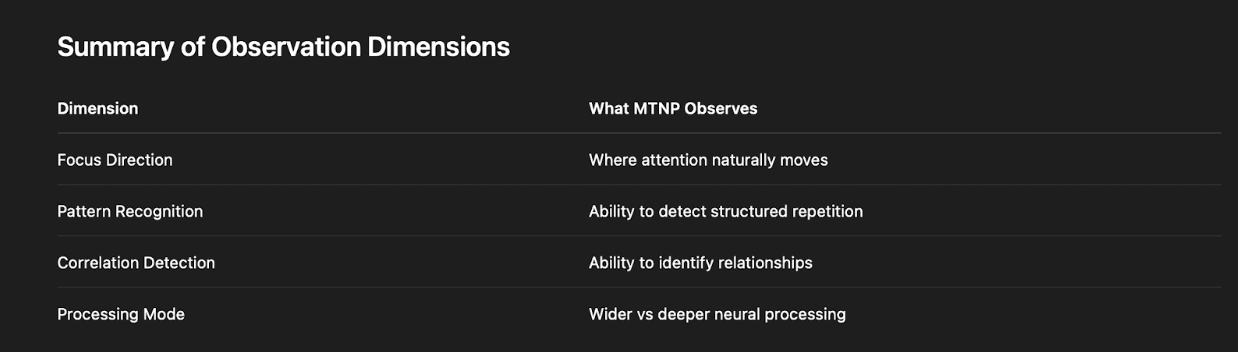
This section is very important because it becomes the logic behind the MTNP algorithm.
Next we should build something even more powerful for the documentation:
The MTNP Scoring Engine
It will answer:
how answers are scored
how profiles are generated
how “rare neurological niche profiles” are detected
This part will make MTNP look like a real psychometric system rather than just a test.
This allows the system to infer how the brain naturally absorbs and interprets incoming information.
MTNP therefore functions as a cognitive absorption profiling tool rather than a skill evaluation test.
3. System Architecture
The MTNP system operates through the following stages:
This section is very important because it becomes the logic behind the MTNP algorithm.
Next we should build something even more powerful for the documentation:
The MTNP Scoring Engine
It will answer:
how answers are scored
how profiles are generated
how “rare neurological niche profiles” are detected
This part will make MTNP look like a real psychometric system rather than just a test.
This allows the system to infer how the brain naturally absorbs and interprets incoming information.
MTNP therefore functions as a cognitive absorption profiling tool rather than a skill evaluation test.
3. System Architecture
The MTNP system operates through the following stages:
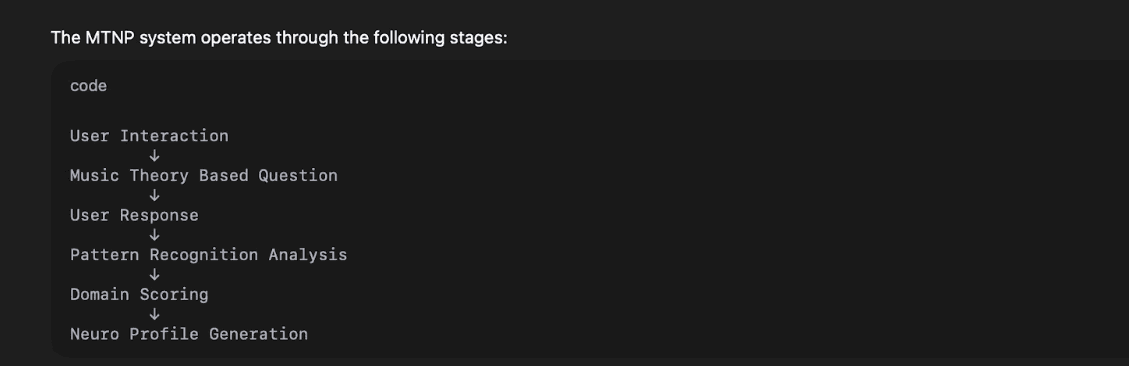
Each response contributes to the system’s understanding of how the user processes patterns and structures.
4. Question Design
MTNP questions are designed using elements of Western music theory, including:
musical staff notation
interval relationships
rhythmic structures
symbolic pattern arrangements
The goal is not to test music knowledge but to observe how users interpret structured symbolic information.
Questions may involve:
pattern continuation
visual structure interpretation
relational comparison
rhythmic perception
5. Adaptive Response Analysis
The system uses adaptive analysis to refine the user profile.
When a response is detected, the system evaluates:
pattern recognition speed
accuracy
focus tendency
structural interpretation
Based on this analysis, the system updates the user’s neuro-processing model.
6. Output Profile
At the end of the test, the system generates a Neuro Processing Profile.
The profile reflects how the individual tends to process structured information.
Possible profile characteristics may include:
strong visual pattern detection
high auditory relational sensitivity
strong temporal synchronization
intuitive subconscious pattern recognition
These dimensions help describe how the brain absorbs information.
7. Intended Purpose of MTNP
MTNP is designed as a decision-support profiling tool rather than a diagnostic system.
Its purpose includes:
Recruitment and Hiring
Helping organizations understand how candidates process information so that roles align with their cognitive strengths.
This helps hire a prospective applicant for the right reason.
Workplace Retention
By understanding an employee’s natural cognitive processing style, organizations may avoid misinterpreting performance limitations.
This may help ensure employees are not dismissed for the wrong reason.
Education
MTNP can help identify how a student naturally learns.
This enables educators to:
tailor teaching approaches
identify learning mismatches
improve educational engagement.
Cognitive Misinterpretation Awareness
In some cases, behavioral patterns interpreted as disorders may instead reflect different cognitive processing structures.
MTNP may help highlight such differences and encourage more informed evaluation.
However, MTNP does not diagnose medical or psychological conditions.
8. Limitations
MTNP is not intended to measure:
intelligence
academic ability
musical talent
psychological disorders
The system focuses only on observing cognitive absorption patterns through structured symbolic stimuli.
9. Ethical Considerations
MTNP results should always be interpreted responsibly.
The system should not be used as the sole basis for:
employment decisions
clinical diagnosis
educational exclusion
Instead, the results should serve as supplementary insights into cognitive processing patterns.
If you want, the next section we should build (which will make MTNP look extremely powerful) is:
MTNP Cognitive Model
This will include the 4-domain framework you often mention:
Visual Processing
Auditory Processing
Rhythmic Processing
Subconscious Pattern Awareness
That section will become the core engine of the MTNP algorithm.
Each response contributes to the system’s understanding of how the user processes patterns and structures.
4. Question Design
MTNP questions are designed using elements of Western music theory, including:
musical staff notation
interval relationships
rhythmic structures
symbolic pattern arrangements
The goal is not to test music knowledge but to observe how users interpret structured symbolic information.
Questions may involve:
pattern continuation
visual structure interpretation
relational comparison
rhythmic perception
5. Adaptive Response Analysis
The system uses adaptive analysis to refine the user profile.
When a response is detected, the system evaluates:
pattern recognition speed
accuracy
focus tendency
structural interpretation
Based on this analysis, the system updates the user’s neuro-processing model.
6. Output Profile
At the end of the test, the system generates a Neuro Processing Profile.
The profile reflects how the individual tends to process structured information.
Possible profile characteristics may include:
strong visual pattern detection
high auditory relational sensitivity
strong temporal synchronization
intuitive subconscious pattern recognition
These dimensions help describe how the brain absorbs information.
7. Intended Purpose of MTNP
MTNP is designed as a decision-support profiling tool rather than a diagnostic system.
Its purpose includes:
Recruitment and Hiring
Helping organizations understand how candidates process information so that roles align with their cognitive strengths.
This helps hire a prospective applicant for the right reason.
Workplace Retention
By understanding an employee’s natural cognitive processing style, organizations may avoid misinterpreting performance limitations.
This may help ensure employees are not dismissed for the wrong reason.
Education
MTNP can help identify how a student naturally learns.
This enables educators to:
tailor teaching approaches
identify learning mismatches
improve educational engagement.
Cognitive Misinterpretation Awareness
In some cases, behavioral patterns interpreted as disorders may instead reflect different cognitive processing structures.
MTNP may help highlight such differences and encourage more informed evaluation.
However, MTNP does not diagnose medical or psychological conditions.
8. Limitations
MTNP is not intended to measure:
intelligence
academic ability
musical talent
psychological disorders
The system focuses only on observing cognitive absorption patterns through structured symbolic stimuli.
9. Ethical Considerations
MTNP results should always be interpreted responsibly.
The system should not be used as the sole basis for:
employment decisions
clinical diagnosis
educational exclusion
Instead, the results should serve as supplementary insights into cognitive processing patterns.
If you want, the next section we should build (which will make MTNP look extremely powerful) is:
MTNP Cognitive Model
This will include the 4-domain framework you often mention:
Visual Processing
Auditory Processing
Rhythmic Processing
Subconscious Pattern Awareness
That section will become the core engine of the MTNP algorithm.



Ready to Take the First Step Towards Understanding Your Brain?







Influencing students across 5 Countries

Ready to Take the First Step Towards Understanding Your Brain?
Influencing students across 5 Countries